


Finance Ghost: Q2 slowdown at MTN Nigeria hits MTN’s share price

On 11 August, the MTN Group released a trading statement that guided 18% to 23% growth in adjusted HEPS for the six months to June 2026(1).
But despite the growth, MTN Group’s share price closed 6% lower on the day. This sharp downward move came after a difficult period in which the stock had already suffered significant selling pressure.
The share price weakness began after MTN Nigeria released its results on 31 July(2). As MTN Nigeria is a material part of the MTN Group, the market places emphasis on the subsidiary’s financial performance.
The further negative response to MTN Group’s trading statement on 11 August could’ve been informed by the expected dip in reported HEPS of between -10% and 0%. Another factor to consider is the comment that the “South African prepaid market continued to be tough in Q2 2026.”
Overall, the MTN Group has shed over 15% of its value between 31 July and 13 August!(3)
As we look ahead to MTN Group releasing detailed interim results on 24 August, which factors could influence the market’s assessment of the telecom?
Focusing on MTN Nigeria — where momentum has slowed
The share price began declining the day MTN Ghana and MTN Nigeria released numbers. Both results would’ve been taken into consideration by the market, but the likely explanation for the negative market response is the financial slowdown in MTN Nigeria’s second quarter (Q2).
After growing 41.8% in Q1, MTN Nigeria’s service revenue increased by just 13.2% in Q2(2). This is a material deceleration in growth.
In the commentary section of the earnings release, MTN Nigeria CEO Karl Toriola referred to a “strong first-half performance, with sustained commercial momentum.” Management focused on the progress made over the six months as a whole — a period in which MTN Nigeria grew service revenue by 25.9% and EBITDA margin by 5.3 percentage points to 55.9%(2).
But the issue was the momentum within the six months, i.e. the growth rate in Q2 vs Q1. Based on the negative market response, it appears that investors focused more on the revenue trend than on underlying margin.
It’s all about exit velocity
Markets are forward-looking. Share prices rise and fall based on future earnings expectations, not just trailing earnings levels. Momentum during a period allows the market to form a view on exit velocity, or the rate at which the business has moved forward into a new period.
This is why the market has focused on answering this key question: is there a structural slowdown in MTN Nigeria, or was there only a temporary issue that has since abated?
Or could both those things be in play?
A rapid decline in Fintech revenue — but only temporarily
This comment in MTN Nigeria’s earnings report(2) is important to this assessment:
“Growth moderated in Q2, primarily reflecting the full annualisation of prior price adjustments and, to a lesser extent, the temporary suspension of our airtime and data credit service, which impacted fintech revenue during the quarter.”
The temporary issue (the suspension of the airtime and data credit service) was in response to regulatory uncertainty that made it too risky for MTN Nigeria to keep offering this service. This directly impacted the Fintech revenue line, which fell 72.4% year-on-year in Q2.
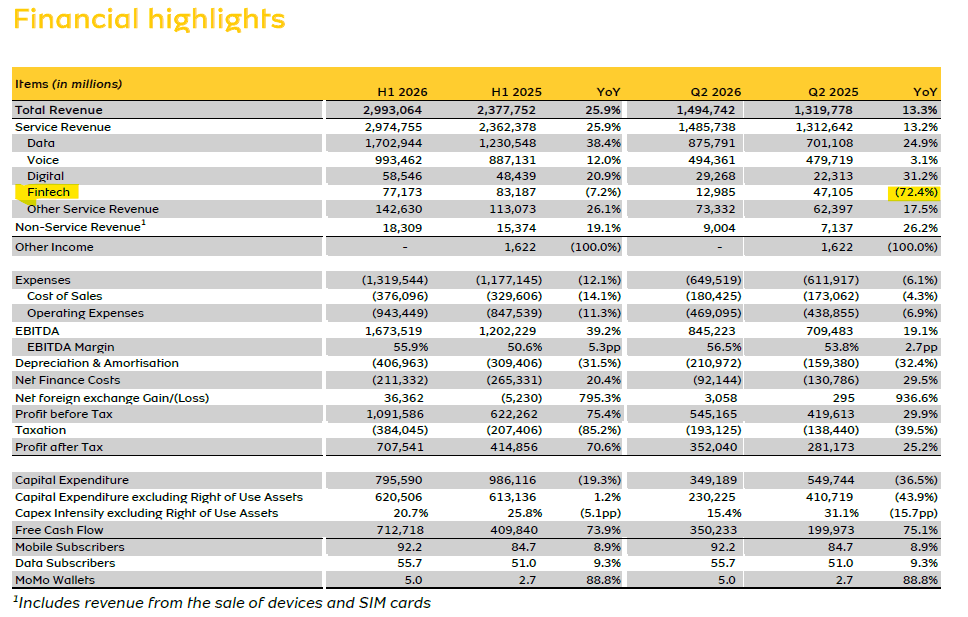
Source: MTN Nigeria results for the six months to June 2026
The situation has now been rectified, with management commenting in the interim report that they are expecting a “stronger contribution from our Fintech business over the remainder of the year.”(2)
The Fintech business contributed only 2.5% of MTN Nigeria’s revenue in the six months. Even after considering the temporary pressure and how this would affect the revenue contribution, this isn’t a material part of MTN Nigeria’s business, let alone the broader MTN Group.
Are there other issues that the market could’ve focused on instead?
Impact of price increases
The aforementioned reference to “full annualisation of prior price adjustments” is relevant here, as MTN Nigeria implemented pricing increases in 2025 to protect EBITDA margins. This creates questions around price elasticity and how these increases could affect demand.
In making this assessment, it’s important to consider the timing of the price increases and how this has skewed the year-on-year comparisons over the past six months.
Growth in Q1 was compared to a base period (Q1’25) before these increases really took hold. In Q2, the pricing increases were in the base period (Q2’25); this is what they mean by “full annualisation”.
This means the second half of the financial year will also have a tough base effect, as the beneficial timing mismatch is now behind us.
This is where the exit velocity concept has practical application, as the market appears to be placing greater weight on the more recent Q2 numbers rather than Q1.
Data and Voice slowdown
The easiest place to see this is in Voice revenue, which contributed 33% of MTN Nigeria’s revenue over six months(2). This important line grew by just 3.1% in Q2 (after increasing by 22.5% in Q1), a notable deterioration in performance.
The largest revenue line in MTN Nigeria is Data revenue, which contributed 57% of revenue over six months(2). Q1 growth of 56.2% moderated to 24.9% in Q2. This is a more resilient performance than Voice, which makes sense as Data is the more robust growth engine based on underlying consumer behaviour. Even then, this is a significant deceleration in performance,
MTN Nigeria’s total expenses grew 6.1% in Q2(2), so Voice revenue growth was below the growth in expenses. The market will likely consider the medium-term impact on EBITDA margins from this concerning trend.
Notably, the strong growth in Data revenue helped EBITDA margin expand from 55.3% in Q1 to 56.5% in Q2.
Looking ahead to MTN Group earnings
Coming into this set of numbers, MTN had been enjoying a strong rally. By close of trade on 30 July, the share price was up 36% year-to-date. This has been a sharp correction, but the share price remains up on both a year-to-date and 12-month basis(3).
The closing price on 11 August of R193.20 is also still well above the 52-week low of R133.16(3).
MTN is a good example of how a stock can experience a rapid correction as it looks for a new consolidation level. Such a period can often have heightened volatility, especially as the market now looks ahead to MTN Group's release of detailed results on 24 August.
Although MTN Nigeria’s service pricing increase was already known to the market, the share price response suggests that the slowdown was worse than the market anticipated. It could also be due to investors becoming concerned that growth rates could moderate further in the second half.
This debate, along with many other market factors, should inform the share price movements in the coming weeks.
Readers should consider both the opportunities and risks discussed above when evaluating the information presented. It’s also important to further research the company’s performance when forming a view, as there are many more bull and bear arguments that can be made.
Disclosure: The Finance Ghost did not hold a position in MTN Group at the time of writing. BROKSTOCK, its employees, representatives or related parties may hold positions in the financial instruments discussed.
(1) MTN Group SENS announcement, 11 August 2026
(2) MTN Nigeria Interim Results for the six months to June 2026
(3) Google Finance data
Disclaimer:
This article is provided for informational purposes only and does not constitute financial advice, a recommendation, an offer, or a solicitation to buy, sell or hold any financial product. The views expressed are based on publicly available information and are intended to present a balanced discussion of potential opportunities and risks. Any forward-looking statements, expectations or opinions are subject to change and may not materialise. Past performance is not indicative of future results. Readers should conduct their own research and consider their individual objectives, financial circumstances and risk tolerance before making any investment decisions. Any investment decision remains the sole responsibility of the reader.
BROKSTOCK SA (Pty) Ltd (FSP No. 51404) acts solely as an authorised financial services provider rendering intermediary services, and does not provide financial advice, discretionary portfolio management or investment recommendations. MTN Group ordinary shares are listed on the JSE. Where MTN exposure is available through BROKSTOCK, it is provided through a JSE share CFD and does not constitute ownership of the underlying MTN shares. CFDs are issued and executed by Standard Bank (SBG Securities (confirm the exact name)). BROKSTOCK SA (Pty) Ltd (FSP No. 51404) acts solely as an intermediary. CFDs are complex derivative instruments and carry a significant risk of loss. Leverage may amplify both gains and losses.
Read also





© 2026 BROKSTOCK SA (PTY) LTD.
BROKSTOCK SA (PTY) LTD is an authorised Financial Service Provider and is regulated by the South African Financial Sector Conduct Authority (FSP No.51404). BROKSTOCK SA (PTY) LTD Proprietary Limited trading as BROKSTOCK. BROKSTOCK SA (PTY) LTD t/a BROKSTOCK acts solely as an intermediary in terms of the FAIS Act, rendering only an intermediary service (i.e., no market making is conducted by BROKSTOCK SA (PTY) LTD t/a BROKSTOCK) in relation to derivative products (CFDs) offered by the liquidity providers. Therefore, BROKSTOCK SA (PTY) LTD t/a BROKSTOCK does not act as the principal or the counterparty to any of its transactions.
The materials on this website (the “Site”) are intended for informational purposes only. Use of and access to the Site and the information, materials, services, and other content available on or through the Site (“Content”) are subject to the laws of South Africa.
Risk notice Margin trading in financial instruments carries a high level of risk, and may not be suitable for all users. It is essential to understand that investing in financial instruments requires extensive knowledge and significant experience in the investment field, as well as an understanding of the nature and complexity of financial instruments, and the ability to determine the volume of investment and assess the associated risks. BROKSTOCK SA (PTY) LTD pays attention to the fact that quotes, charts and conversion rates, prices, analytic indicators and other data presented on this website may not correspond to quotes on trading platforms and are not necessarily real-time nor accurate. The delay of the data in relation to real-time is equal to 15 minutes but is not limited. This indicates that prices may differ from actual prices in the relevant market, and are not suitable for trading purposes. Before deciding to trade the products offered by BROKSTOCK SA (PTY) LTD, a user should carefully consider his objectives, financial position, needs and level of experience. The Content is for informational purposes only and it should not construe any such information or other material as legal, tax, investment, financial, or other advice. BROKSTOCK SA (PTY) LTD will not accept any liability for loss or damage as a result of reliance on the information contained within this Site including data, quotes, conversion rates, etc.
Third party content BROKSTOCK SA (PTY) LTD may provide materials produced by third parties or links to other websites. Such materials and websites are provided by third parties and are not under BROKSTOCK SA (PTY) LTD's direct control. In exchange for using the Site, the user agrees not to hold BROKSTOCK SA (PTY) LTD, its affiliates or any third party service provider liable for any possible claim for damages arising from any decision user makes based on information or other Content made available to the user through the Site.
Limitation of liability The user’s exclusive remedy for dissatisfaction with the Site and Content is to discontinue using the Site and Content. BROKSTOCK SA (PTY) LTD is not liable for any direct, indirect, incidental, consequential, special or punitive damages. Working with BROKSTOCK SA (PTY) LTD you are trading share CFDs. When trading CFDs on shares you do not own the underlying asset. Share CFDs are complex instruments and come with a high risk of losing money rapidly due to leverage. A high percentage of retail traders accounts lose money when trading CFDs with their provider. All rights reserved. Any use of Site materials without permission is prohibited.