


Finance Ghost: Afrimat is navigating “some of the hardest times” in two decades

On 10 April 2024, Afrimat announced that the Competition Tribunal had approved the acquisition of Lafarge South Africa(1). The transaction was designed to increase Afrimat's exposure to the construction materials sector through a national footprint of quarries and ready-mix operations, while giving the group a way to "enter the cement value chain competitively."
The deal was pitched as an important step in Afrimat's diversification strategy. Some investors raised concerns about the inherent risk in this transaction, particularly given its size and the extent of work needed to fix Lafarge’s troubled assets. At the time, the track record of Afrimat’s management team allayed many of the fears.
On that day, Afrimat's share price closed at around R60.00. It closed at R25.80 on 27th August(2).
With the share price having lost nearly 60% since that announcement, can the company overcome what it refers to as “some of the hardest times” faced by the company in its 20-year history?(3)
A perfect storm
It would be unfair to attribute all of that value destruction to the Lafarge acquisition. There are many other factors at play at the moment that have contributed to the sharp negative swing in market sentiment. These include a mix of domestic and international market challenges, giving us a reminder that Afrimat’s fortunes are still largely tied to commodity prices that sit outside of management’s control.
There’s no way of knowing for sure, but the market might have formed a different view on the Lafarge deal if the rest of Afrimat’s business hadn’t come under this much pressure at the same time.
This is a great real-life example of the risk of doing transformative transactions vs. bolt-on or smaller deals. High-stakes dealmaking can prove to be a painful experience for all involved.
Confidence vs. a need to diversify
Bears may even argue that Afrimat had become too confident based on the successful track record of diversification, leading to the decision to take on arguably the riskiest deal in the company’s history.
Bulls could counter this by pointing out that Afrimat’s diversification is perhaps its greatest asset right now, giving the group more resilience than would otherwise be the case.
The debate rages on in the market, but the fact is that pressure has been building across iron ore, cement and other key markets. At time of writing, the share price is trading close to the 52-week low of R25.20, having dropped nearly 40% year-to-date.
Sentiment is one factor here, but there’s also observable pressure on earnings.
Where did the weakening rand go?
For two decades, the rand seemed to be on a one-way trajectory relative to the US dollar. Many South African corporates positioned themselves accordingly, building strong export businesses that would benefit from a weakening rand.
But in the past year, the rand has strengthened by roughly 5% against the greenback. This heavily influences the profitability of the export business, particularly in commodities like iron ore.
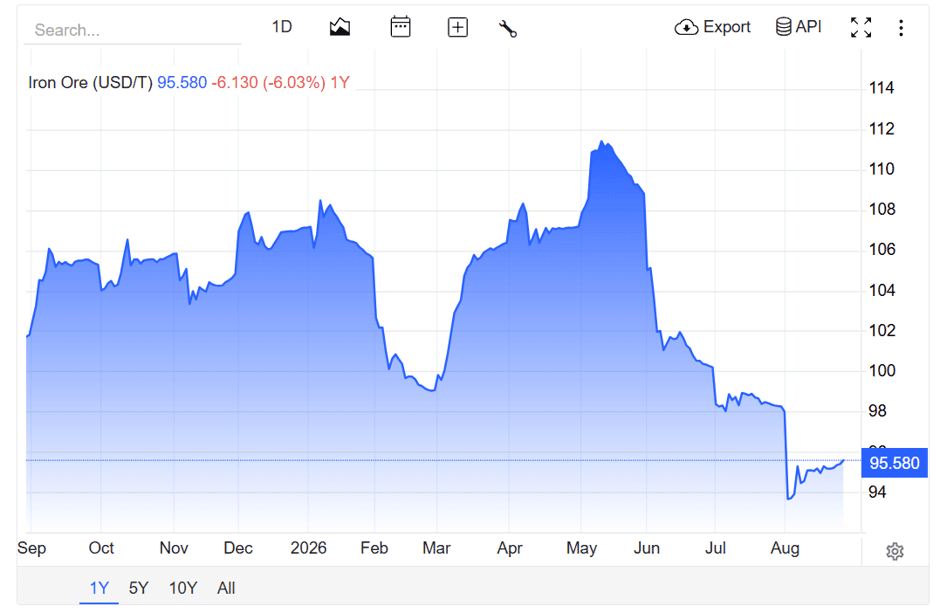
To make things worse, USD-denominated iron ore prices have been extremely volatile in 2026. The price is approximately 6% down over 12 months(4).
Source: tradingeconomics.com
With heightened global macroeconomic risks in an environment of conflict and elevated shipping costs, this leaves Afrimat exposed to an unforgiving global iron ore market.
Green shoots in Q2 – but they are vulnerable
Although Afrimat has flagged that results for the six months ending August 2026 will be “adversely affected by concurrent external shocks”, there is some positive momentum. This has given management hope that the second half of the year will be better than the first half.
One of the improvements lies in domestic iron ore sales, which improved in the second quarter relative to the first quarter after supply patterns at ArcelorMittal South Africa normalised. Afrimat noted that demand in the first quarter had been distorted by "erratic demand patterns", with ArcelorMittal drawing down existing stockpiles rather than purchasing material at normal levels.
But even this source of momentum is shaky at best, as ArcelorMittal remains under severe financial pressure, serving as a stark reminder of the challenges facing South Africa's broader industrial economy. These issues flow up the value chain to companies like Afrimat.
On the iron ore export side, rail logistics have improved, with Afrimat describing Transnet’s services as becoming more reliable. This is encouraging news that offsets some of the pain from rand-denominated iron ore prices, although Afrimat has flagged a maintenance shutdown in October 2026 at Transnet that will keep volumes roughly 10% below the allocation of 870 000 tonnes per annum.
The ferrochrome smelter industry is another source of cautious optimism. Following the approval of discounted electricity tariffs for smelters, several operations have begun returning to production, creating an opportunity for domestic anthracite demand to recover. Improvement is only gradual though, with Afrimat's Nkomati Anthracite Mine ramping up supply into the local market. Still, this is good news, as the export market as a forced alternative has lower prices than the domestic market.
And what of Lafarge, the deal that has been central to the recent debates around Afrimat?
The company refers to a "meaningful and growing contribution" from the aggregates and fly ash operations, bringing some positivity to the debate around whether this deal should’ve happened at all. But management is also keeping its options open, noting that it is investigating “various strategic alternatives” for the integrated cement operation.
With Afrimat describing the cement and extenders business as having been "painstakingly rebuilt from the ground up" in the aftermath of the Lafarge transaction, bulls will be hoping that some ground-up improvement will come for the share price as well.
A share price in search of a bottom
For a share price to turn the corner and form a new bull trend, it first needs to find a bottom. Afrimat’s management has given the market some sources of positivity, but there’s an overall air of bearishness that is hard to ignore. This is reflected by the weakness in the share price this year.
Much of the bull case rests on a view that a perfect storm cannot carry on forever. Mining and industrial businesses are cyclical in nature, so bad times come and go. It’s unusual for the bad times to arrive simultaneously across multiple underlying products. There’s no guarantee that the good times will arrive together as well, or that they will arrive at all in the near-term. But mining and industrial cycles have historically changed over time, with Afrimat needing to focus on surviving the immediate pressure in an environment where the timing and extent of any recovery remain uncertain.
What could improve the company’s fortunes?
Global iron ore prices are key to watch, with the USD/ZAR exchange rate as another important factor. A decline in shipping costs would also be helpful, so the war in Iran is highly relevant. In South Africa, improvements at ArcelorMittal and the ferrochrome smelter industry could give Afrimat some relief, while any news on the strategic plans for the cement business could materially influence market sentiment and the share price.
Naturally, a further deterioration in any of these factors could put even more pressure on Afrimat’s share price.
Afrimat has promised to update the market in September once they have greater certainty about the company’s financial position. It’s not clear at this point just how severely the balance sheet has been impacted, with Afrimat noting that “cash generation and debt reduction are the main priorities”.
Ahead of that update, the market will monitor the aforementioned global macroeconomic and geopolitical factors, as they could have a meaningful influence on the share price and operating performance.
The great irony of Afrimat’s diversification strategy is that it is being deeply questioned precisely at the time when it is needed most.
Readers should consider both the opportunities and risks discussed above when evaluating the information presented. It's also important to further research the company's performance when forming a view, as there are many more bull and bear arguments that can be made.
Disclosure: The Finance Ghost holds a long position in Afrimat at the time of writing. BROKSTOCK, its employees, representatives or related parties may hold positions in the financial instruments discussed.
(2) Google Finance
(3) Afrimat business update and pre-close briefing session, released on SENS on 25 August 2026
Disclaimer: This article is provided for informational purposes only and does not constitute financial advice, a recommendation, an offer, or a solicitation to buy, sell or hold any financial product. The views expressed are based on publicly available information and are intended to present a balanced discussion of potential opportunities and risks. Any forward-looking statements, expectations or opinions are subject to change and may not materialise. Past performance is not indicative of future results. Readers should conduct their own research and consider their individual objectives, financial circumstances and risk tolerance before making any investment decisions. Any investment decision remains the sole responsibility of the reader.
BROKSTOCK SA (Pty) Ltd (FSP No. 51404) acts solely as an authorised financial services provider rendering intermediary services, and does not provide financial advice, discretionary portfolio management or investment recommendations. Afrimat ordinary shares are listed on the JSE. Where Afrimat exposure is available through BROKSTOCK, it is provided through a JSE share CFD and does not constitute ownership of the underlying Afrimat shares. BROKSTOCK SA (Pty) Ltd (FSP No. 51404) acts solely as an intermediary. CFDs are complex derivative instruments and carry a significant risk of loss. Leverage may amplify both gains and losses.
Read also




© 2026 BROKSTOCK SA (PTY) LTD.
BROKSTOCK SA (PTY) LTD is an authorised Financial Service Provider and is regulated by the South African Financial Sector Conduct Authority (FSP No.51404). BROKSTOCK SA (PTY) LTD Proprietary Limited trading as BROKSTOCK. BROKSTOCK SA (PTY) LTD t/a BROKSTOCK acts solely as an intermediary in terms of the FAIS Act, rendering only an intermediary service (i.e., no market making is conducted by BROKSTOCK SA (PTY) LTD t/a BROKSTOCK) in relation to derivative products (CFDs) offered by the liquidity providers. Therefore, BROKSTOCK SA (PTY) LTD t/a BROKSTOCK does not act as the principal or the counterparty to any of its transactions.
The materials on this website (the “Site”) are intended for informational purposes only. Use of and access to the Site and the information, materials, services, and other content available on or through the Site (“Content”) are subject to the laws of South Africa.
Risk notice Margin trading in financial instruments carries a high level of risk, and may not be suitable for all users. It is essential to understand that investing in financial instruments requires extensive knowledge and significant experience in the investment field, as well as an understanding of the nature and complexity of financial instruments, and the ability to determine the volume of investment and assess the associated risks. BROKSTOCK SA (PTY) LTD pays attention to the fact that quotes, charts and conversion rates, prices, analytic indicators and other data presented on this website may not correspond to quotes on trading platforms and are not necessarily real-time nor accurate. The delay of the data in relation to real-time is equal to 15 minutes but is not limited. This indicates that prices may differ from actual prices in the relevant market, and are not suitable for trading purposes. Before deciding to trade the products offered by BROKSTOCK SA (PTY) LTD, a user should carefully consider his objectives, financial position, needs and level of experience. The Content is for informational purposes only and it should not construe any such information or other material as legal, tax, investment, financial, or other advice. BROKSTOCK SA (PTY) LTD will not accept any liability for loss or damage as a result of reliance on the information contained within this Site including data, quotes, conversion rates, etc.
Third party content BROKSTOCK SA (PTY) LTD may provide materials produced by third parties or links to other websites. Such materials and websites are provided by third parties and are not under BROKSTOCK SA (PTY) LTD's direct control. In exchange for using the Site, the user agrees not to hold BROKSTOCK SA (PTY) LTD, its affiliates or any third party service provider liable for any possible claim for damages arising from any decision user makes based on information or other Content made available to the user through the Site.
Limitation of liability The user’s exclusive remedy for dissatisfaction with the Site and Content is to discontinue using the Site and Content. BROKSTOCK SA (PTY) LTD is not liable for any direct, indirect, incidental, consequential, special or punitive damages. Working with BROKSTOCK SA (PTY) LTD you are trading share CFDs. When trading CFDs on shares you do not own the underlying asset. Share CFDs are complex instruments and come with a high risk of losing money rapidly due to leverage. A high percentage of retail traders accounts lose money when trading CFDs with their provider. All rights reserved. Any use of Site materials without permission is prohibited.