


Finance Ghost: Thungela marks five years as a listed company with strong interim results

In June 2021, just over five years ago, Anglo American unbundled Thungela and handed investors a standalone thermal coal producer at a time when the sector was deeply out of favour.
Since then, Thungela’s total shareholder return stands at around 355%(1). Of course, such a return is not indicative of future potential returns. But this number does give us an interesting insight: share price growth was only 113% over the period, so most of the return came from dividends.
The coal market is highly cyclical and impacted by numerous global factors, yet Thungela has achieved a strong through-the-cycle performance.
After substantial profit growth in the latest interim results, and with energy prices in the spotlight as conflict escalates once more in Iran, let’s take a closer look at Thungela.
Benchmark coal prices are just one indication of growth
For the interim, benchmark coal prices increased 15% in South Africa and 25% in Australia(2). This would suggest a period of outsized revenue growth for Thungela, yet it grew only 2%.
There are far more exciting numbers further down the income statement (like HEPS and dividend per share), but it’s worth understanding this disconnect from the benchmark prices as a starting point.
One of the factors is the weaker US dollar. Export-oriented coal producers prefer a stronger US dollar, as that means weaker local currency in the markets where they operate their mines. This increases the value of their export products. But recent global economic upheaval has driven the opposite outcome, with the US dollar weakness blunting the spike in benchmark prices.
Another critical nuance is that coal is not a single global market. This is part of why Thungela diversified with the Ensham deal in Australia in 2023.
In the latest earnings commentary, Thungela pointed out that South African coal is heavily exposed to India, where cost-sensitive buyers place an effective ceiling on how far prices can rise before demand starts adjusting. In contrast, the Australian operations have greater exposure to Northeast Asian markets, where factors including electricity supply disruptions in China have supported pricing.
Another factor at play is that realised prices in Australia came under pressure as previously contracted fixed-price tonnes traded at a larger discount to benchmark prices than investors might have expected. Management believes this effect should moderate in the second half.
Finally, Thungela lost domestic revenue due to the Isibonelo closure after the mine reached the end of its useful economic life in December 2025.
This slide from the investor presentation shows how each of these factors impacted revenue:
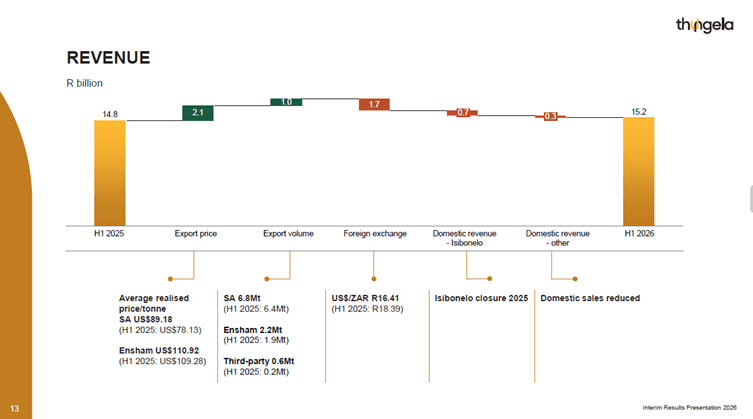
Benchmark coal prices are clearly only one piece of the puzzle. Customer mix, regional demand, exchange rates, product quality and contract structures all influence the revenue that ultimately reaches the income statement.
Green shoots at Transnet Freight Rail
In order to benefit from global markets, Thungela’s coal needs to arrive at the ports. Transnet Freight Rail has been a drag on energy exports in South Africa for years now, but the public-private partnership and associated initiatives to address this situation are bearing fruit.
With South African export sales up 12%, Thungela took advantage of Transnet’s improved performance and the additional rail allocation opportunities across the export corridor.
But it’s not just about the amount of coal reaching the port. The quality mix also matters, as a weaker one during the period reduced some of the pricing benefits expected when the benchmark price moved up.
Operational discipline is evident
Overall, South African production was broadly in line with the prior year despite the cessation of mining activities at Goedehoop North. This suggests that the balance of the portfolio absorbed the impact of Goedehoop North ending operations, highlighting resilience in the remaining operations.
Although the business had to contend with external shocks like diesel price increases, management achieved South African FOB cost per export tonne of R1 374, which is within guidance. That’s an 8.7% increase year-on-year. Guidance for the full year has been maintained based on expected second-half improvements.
Profits and cash generation
Thungela’s revenue growth and cost per export tonne may look concerning when viewed together, but there’s a big piece of the puzzle that is missing from that analysis. As Thungela achieved revenue growth with a smaller operating footprint, following the closure of Isibonelo and the end of mining activities at Goedehoop North, group operating costs declined 5.1%.
This is different to the metrics that measure underlying cost pressures at the continuing operations, like the cost per export tonne.
The point is that Thungela’s overall cost base has dropped significantly, which drove a 91% increase in adjusted EBITDA to R1.3 billion, while the EBITDA margin improved from 4.7% to 8.7%.
This, along with other factors like a reduction in interest expenses, is why headline earnings per share (HEPS) jumped 150%. The dividend per share rose 175%.
And with the sustaining capital expenditure remaining broadly flat at around R705 million, adjusted operating free cash flow surged from R484 million to R1.9 billion.
A harvesting phase in the capital cycle
Thungela’s 2026 guidance includes just R100 million expansionary capital expenditure in South Africa. There’s no expected expansionary capital expenditure in Australia. For context, the sustaining capital expenditure is expected to be between R700 million and R1 billion in South Africa and between R500 million and R700 million at Ensham.
This means that Thungela is focusing on its existing assets, rather than undertaking costly expansion programmes. This suggests a harvesting phase in the capital cycle rather than a heavy investment phase, supported by the interim dividend per share exceeding the minimum payout threshold of 30% of adjusted operating free cash flow.
A final point to mention is that through completed and pending asset disposals, management believes that South African environmental liabilities will be fully cash-collateralised by year-end. Rehabilitation liabilities are a reality of mining and can negatively impact the valuation if their funding is unclear. This represents a meaningful derisking of Thungela's longer-term profile.
Single commodity exposure is always risky
Despite all the recent positives, the market knows that Thungela remains a pure-play coal company.
Coal prices are notoriously difficult to forecast. Geopolitical developments, including tensions involving Iran and their impact on global energy markets, can influence prices. So can weather patterns, renewable energy investment, economic growth rates and government policy decisions.
To add to the complexity in forecasting revenue, we’ve also seen how its growth can be disconnected from the underlying benchmark prices.
Management can control costs, production, logistics and capital allocation. But they cannot control or even influence the coal price, leaving Thungela’s fate largely in the hands of broader market dynamics.
Coal arguably has strong long-term fundamentals due to its critical role in providing heat and energy, especially in emerging markets where there isn’t enough capital available for renewable energy projects capable of materially reducing the reliance on fossil fuels. This may support coal demand over time, but it’s no guarantee that prices will go up, or even remain stable.
Looking ahead
Thungela’s R116.30 share price at the time of writing is slightly below the mid-point of the 52-week range (R73.10 low and R180.61 high). It’s been a volatile period for the stock, with an initial spike based on the Iran conflict breaking out, followed by a correction in late June/early July.
The price is up 17% over seven days, suggesting renewed interest in the stock. Given Thungela's sensitivity to both commodity prices and geopolitical developments, investors will continue to watch developments in global energy markets closely.
With a longer-term view, Thungela’s dividend track record has shown an ability to drive shareholder returns despite substantial volatility in both earnings and share price. As management looks to navigate the long-term fundamentals of coal, the market will constantly need to consider the mix of short-term factors and long-term opportunities in this space.
Readers should consider both the opportunities and risks discussed above when evaluating the information presented. It's also important to further research the company's performance when forming a view, as there are many more bull and bear arguments that can be made.
Disclosure: The Finance Ghost does not hold a position in Thungela at the time of writing. BROKSTOCK, its employees, representatives or related parties may hold positions in the financial instruments discussed.
(1) Moneyweb data, 19 August 2026, calculated based on a five-year period back to 19 August 2021. This does not include transaction costs or taxes and is not indicative of a CFD return over the same period.
(2) All financial metrics and management commentary based on Thungela’s interim results for the six months ended June 2026
Disclaimer: This article is provided for informational purposes only and does not constitute financial advice, a recommendation, an offer, or a solicitation to buy, sell or hold any financial product. The views expressed are based on publicly available information and are intended to present a balanced discussion of potential opportunities and risks. Any forward-looking statements, expectations or opinions are subject to change and may not materialise. Past performance is not indicative of future results. Readers should conduct their own research and consider their individual objectives, financial circumstances and risk tolerance before making any investment decisions. Any investment decision remains the sole responsibility of the reader.
BROKSTOCK SA (Pty) Ltd (FSP No. 51404) acts solely as an authorised financial services provider rendering intermediary services, and does not provide financial advice, discretionary portfolio management or investment recommendations. Thungela ordinary shares are listed on the JSE. Where Thungela exposure is available through BROKSTOCK, it is provided through a JSE share CFD and does not constitute ownership of the underlying Thungela shares. BROKSTOCK SA (Pty) Ltd (FSP No. 51404) acts solely as an intermediary. CFDs are complex derivative instruments and carry a significant risk of loss. Leverage may amplify both gains and losses.
Read also





© 2026 BROKSTOCK SA (PTY) LTD.
BROKSTOCK SA (PTY) LTD is an authorised Financial Service Provider and is regulated by the South African Financial Sector Conduct Authority (FSP No.51404). BROKSTOCK SA (PTY) LTD Proprietary Limited trading as BROKSTOCK. BROKSTOCK SA (PTY) LTD t/a BROKSTOCK acts solely as an intermediary in terms of the FAIS Act, rendering only an intermediary service (i.e., no market making is conducted by BROKSTOCK SA (PTY) LTD t/a BROKSTOCK) in relation to derivative products (CFDs) offered by the liquidity providers. Therefore, BROKSTOCK SA (PTY) LTD t/a BROKSTOCK does not act as the principal or the counterparty to any of its transactions.
The materials on this website (the “Site”) are intended for informational purposes only. Use of and access to the Site and the information, materials, services, and other content available on or through the Site (“Content”) are subject to the laws of South Africa.
Risk notice Margin trading in financial instruments carries a high level of risk, and may not be suitable for all users. It is essential to understand that investing in financial instruments requires extensive knowledge and significant experience in the investment field, as well as an understanding of the nature and complexity of financial instruments, and the ability to determine the volume of investment and assess the associated risks. BROKSTOCK SA (PTY) LTD pays attention to the fact that quotes, charts and conversion rates, prices, analytic indicators and other data presented on this website may not correspond to quotes on trading platforms and are not necessarily real-time nor accurate. The delay of the data in relation to real-time is equal to 15 minutes but is not limited. This indicates that prices may differ from actual prices in the relevant market, and are not suitable for trading purposes. Before deciding to trade the products offered by BROKSTOCK SA (PTY) LTD, a user should carefully consider his objectives, financial position, needs and level of experience. The Content is for informational purposes only and it should not construe any such information or other material as legal, tax, investment, financial, or other advice. BROKSTOCK SA (PTY) LTD will not accept any liability for loss or damage as a result of reliance on the information contained within this Site including data, quotes, conversion rates, etc.
Third party content BROKSTOCK SA (PTY) LTD may provide materials produced by third parties or links to other websites. Such materials and websites are provided by third parties and are not under BROKSTOCK SA (PTY) LTD's direct control. In exchange for using the Site, the user agrees not to hold BROKSTOCK SA (PTY) LTD, its affiliates or any third party service provider liable for any possible claim for damages arising from any decision user makes based on information or other Content made available to the user through the Site.
Limitation of liability The user’s exclusive remedy for dissatisfaction with the Site and Content is to discontinue using the Site and Content. BROKSTOCK SA (PTY) LTD is not liable for any direct, indirect, incidental, consequential, special or punitive damages. Working with BROKSTOCK SA (PTY) LTD you are trading share CFDs. When trading CFDs on shares you do not own the underlying asset. Share CFDs are complex instruments and come with a high risk of losing money rapidly due to leverage. A high percentage of retail traders accounts lose money when trading CFDs with their provider. All rights reserved. Any use of Site materials without permission is prohibited.